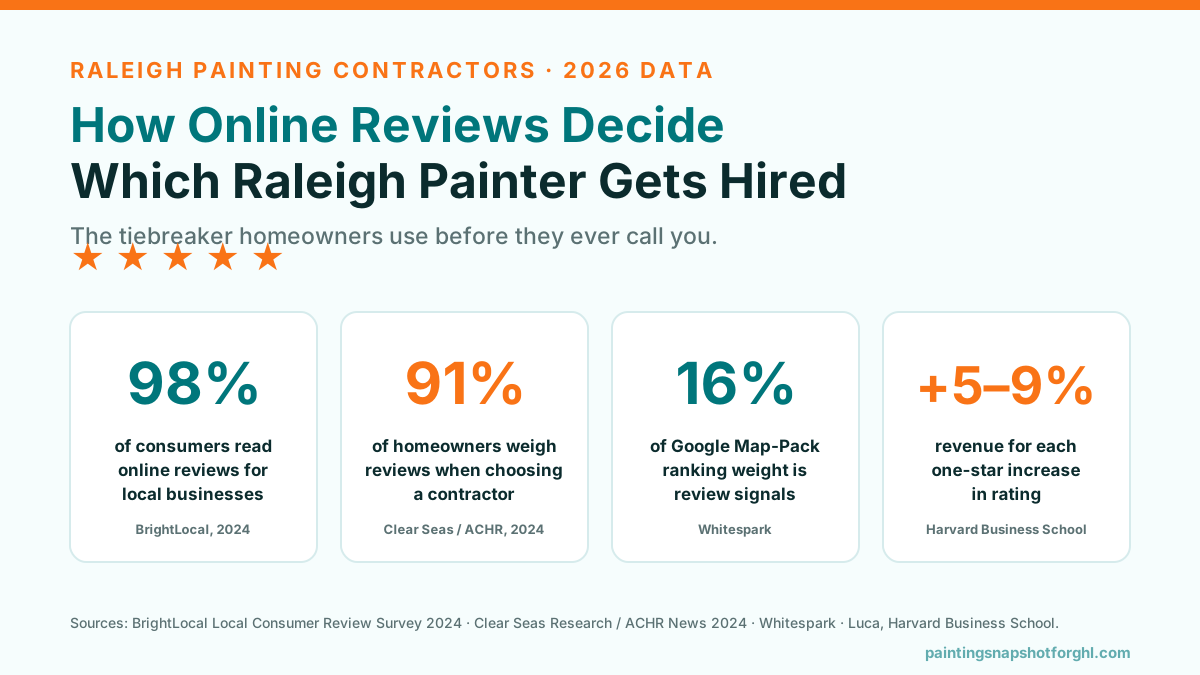
For a Raleigh homeowner deciding between three painters with similar bids, the tiebreaker usually isn’t price or the estimate — it’s your reviews. Nearly everyone reads them before they call (98% of consumers read online reviews for local businesses, per BrightLocal, 2024), 91% of homeowners say reviews are an important factor when choosing a contractor (Clear Seas Research / ACHR News, 2024), and your star rating quietly controls both whether a homeowner trusts you and whether Google shows you in the Map Pack at all. This post lays out the 2026 data on exactly how reviews decide who gets the paint job in a market as competitive as Raleigh — how many reviews and what rating you actually need, why recency and owner responses matter as much as the star count, and how the painters who win the review game earn fresh 5-star reviews automatically after every job instead of begging for them one awkward text at a time.
In this post
- Why reviews are the tiebreaker in Raleigh
- Do homeowners really read reviews before hiring a painter?
- How many reviews — and what rating — you actually need
- Reviews decide your Google Map Pack ranking, not just trust
- What a better rating is worth in real dollars
- The part most painters miss: recency and responses
- Why manual review-chasing fails — and what to do instead
- Frequently asked questions
Why reviews are the tiebreaker in Raleigh
Raleigh is one of the best places in the country to run a painting business — and that’s exactly why reviews matter so much here. The city officially passed 506,306 residents in 2025, making it North Carolina’s second-largest city after years of heavy in-migration (NC OSBM, 2025). It holds roughly 203,000 households at a 50.7% owner-occupied rate, with a median owner-occupied home value of $415,800 — well above the national median (U.S. Census QuickFacts). Every one of those higher-value homes in North Hills, Five Points, Cary, and Apex is a future interior repaint, exterior refresh, or cabinet job.
Zoom out and the opportunity is enormous: U.S. house-painting and decorating contractors are a roughly $28.2 billion industry with about 223,000 businesses (IBISWorld, 2025). That second number is the problem. Demand isn’t the constraint in Raleigh — competition is. When a homeowner in Wake County searches “house painters near me,” they get a screen full of crews who all look roughly the same: similar websites, similar “licensed and insured” badges, similar ballpark prices. The thing that separates the painter who gets the call from the three who don’t is the block of gold stars under each name.
That’s what makes reviews the tiebreaker. You rarely lose a Raleigh job because a homeowner studied your bid and chose someone cheaper. You lose it earlier and more quietly — at the moment they scanned the search results, compared your 4.2 stars and 11 reviews against a competitor’s 4.9 stars and 140 reviews, and simply never reached out. (It’s the reputation version of the speed problem we cover in missed-call text-back for painters: the job is won or lost before you ever know the lead existed.)
Do homeowners really read reviews before hiring a painter?
Yes — almost universally, and even more so for a high-trust, in-the-home purchase like painting. 98% of consumers read online reviews for local businesses, and the habit is now so ingrained that only a tiny fraction ever skip them (BrightLocal, 2024). For the contractor category specifically, 91% of homeowners say online reviews are an important factor when choosing a contractor (Clear Seas Research / ACHR News, 2024).
It’s not just the star count they read, either. Homeowners read the responses, too. 88% of consumers would use a business that replies to all of its reviews, compared with only 47% who would use a business that never responds to reviews at all (BrightLocal, 2024). In other words, an un-answered review section doesn’t just look neglected — it roughly halves the share of homeowners willing to hire you.
Share of consumers exhibiting each review behavior (%). Reading reviews is near-universal, and responding to them roughly doubles the share of buyers willing to hire you. Sources: BrightLocal Local Consumer Review Survey, 2024; Clear Seas Research / ACHR News, 2024 (home-services contractors).
For a Raleigh painting shop, that’s the whole ballgame in two numbers. The homeowner comparing you to the crew across town isn’t a hard sell once they call — they’re already inclined to hire a painter. The question is whether your reviews get you into the short list of two or three they actually contact. Reviews are the filter that happens before the conversation.
How many reviews — and what rating — you actually need
There’s no magic number, but the research points to a clear working target for a local contractor: a rating of 4.5 stars or better, on a base of reviews large and recent enough to look credible. Consumers increasingly screen out low-rated businesses entirely — a business sitting at 3.8 stars often never makes the shortlist, regardless of price. And a handful of reviews reads as “new and unproven” next to a competitor with a deep, steady stream.
Here’s the practical way to think about it for Raleigh:
- Rating floor: 4.5+. Below roughly 4.0, a meaningful share of homeowners filter you out before reading a word. The goal isn’t a perfect 5.0 (which can even read as fake) — it’s a solid 4.6–4.9 that clears the bar.
- Volume that beats your local competitors. Review count is relative. If the top three painters ranking for “Raleigh house painters” have 90–150 Google reviews, then 15 reviews makes you look like the risky choice even at 5.0 stars. Your target is “more and fresher than the crews you’re losing jobs to,” not an absolute.
- A steady drip, not a one-time push. Twenty reviews earned over two years looks worse than twenty earned over the last six months, because buyers and Google both weight recency (more on that below).
The uncomfortable takeaway: most painting shops don’t have a quality problem, they have a collection problem. You finished 120 jobs last year and delighted most of those customers — but if only 11 of them left a review, your profile tells homeowners you’re a small, untested operation. The reviews exist as goodwill in your customers’ heads; they just never made it onto Google. Closing that gap is the single highest-leverage reputation move a Raleigh painter can make, and it’s covered step-by-step in how to get more 5-star painting reviews on autopilot.
Reviews decide your Google Map Pack ranking, not just trust
Most painters think of reviews as a trust thing — social proof that convinces a homeowner who already found you. That’s only half the story. Reviews are also one of the biggest factors in whether Google shows you at all in the local “Map Pack” (the three businesses with the map that sit above the regular results for “painters near me”).
In the most widely cited breakdown of Google’s local algorithm, review signals account for roughly 16% of local-pack ranking weight — behind only your Google Business Profile signals (about 32%) and on-page signals (about 19%), and ahead of links, behavioral signals, and citations (Whitespark / BrightLocal local ranking factors).
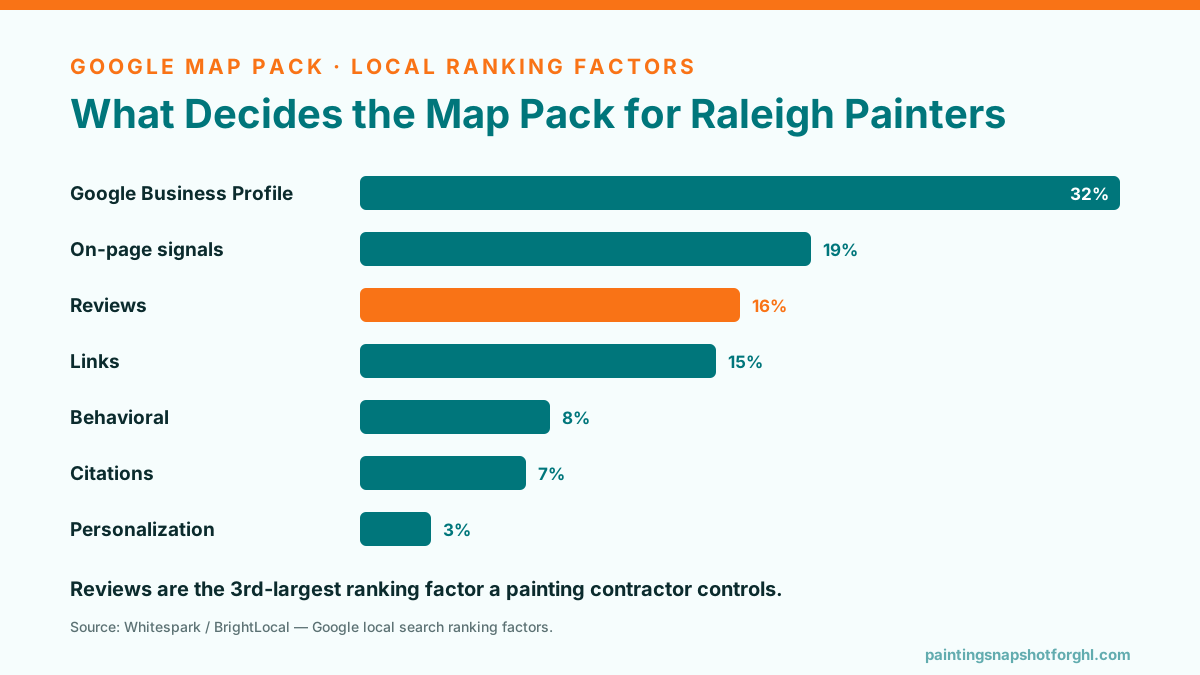
Estimated share of Google local-pack ranking weight by factor (%). Review signals are the third-largest lever a painting contractor controls. Source: Whitespark / BrightLocal, Google local algorithm & ranking factors.
This is why reviews compound. A steady flow of fresh, keyword-rich reviews (“they repainted our whole interior in Cary and the trim work was flawless”) doesn’t just convince the homeowner who lands on your profile — it helps push you up into the Map Pack where more homeowners see you in the first place. That’s the flywheel: better reviews → higher local ranking → more profile views → more reviews. It’s the same engine behind everything in local SEO for painters; reviews are the fuel.
What a better rating is worth in real dollars
Reviews aren’t a vanity metric — they move revenue, and there’s hard research to prove it. The landmark study here is Harvard Business School economist Michael Luca’s analysis of Yelp ratings, which found that a one-star increase in rating led to a 5–9% increase in revenue (Luca, Harvard Business School). That study looked at restaurants, but the mechanism is identical for a home-service business: a higher rating pulls more of the people who see you into actually choosing you.
Put that in painting terms. Say a Raleigh shop books 120 jobs a year at an average ticket of $3,500 — about $420,000 in revenue. If lifting your rating from 4.1 to 4.6 and deepening your review base moves even a conservative 6% more of your shortlist appearances into booked jobs, that’s roughly $25,000 in additional revenue a year from reputation alone — on work you’re already qualified to win. No new ad spend, no new crews. Just capturing the jobs you’re currently losing at the review-comparison step.
The part most painters miss: recency and responses
Two factors quietly decide whether your reviews are actually working — and most painters ignore both.
Recency. A 4.8-star rating built on reviews from 2022 reassures almost no one in 2026. Homeowners instinctively look at the dates, and a profile whose last review is eight months old reads as “are they even still in business?” Google appears to weight recency too — a fresh, steady stream of reviews signals an active, relevant business. Older small-business research from Womply found that businesses with a steady flow of recent reviews earned materially more than those without (Womply, via Search Engine Land) — directionally, fresh reviews beat a once-great profile that’s gone quiet. The implication: you need reviews coming in every week, not in occasional bursts when you remember to ask.
Responses. As noted above, 88% of consumers favor a business that replies to all its reviews, versus 47% for one that never responds (BrightLocal, 2024). A thoughtful reply — even a quick “Thanks, Maria! The team loved brightening up that Five Points kitchen” — signals an owner who cares, and a calm, professional response to the occasional critical review reassures far more than a flawless-but-silent profile. Yet responding to every review by hand is exactly the kind of task a busy owner drops during peak season.
Recency and responses are where good intentions go to die. Every painter means to ask for reviews and reply to them. Almost none do it consistently, because both depend on a human remembering, at the exact right moment, in the middle of running crews. That’s the real reason most profiles stall — not attitude, but the absence of a system.
Why manual review-chasing fails — and what to do instead
The manual version of review collection is some combination of “I’ll text them later,” a stack of business cards with a QR code, and the occasional guilt-driven batch of asks when the profile looks thin. It fails for the same reason most back-office tasks fail: it competes with painting for the owner’s attention, and painting always wins. The result is exactly what we see on most Raleigh painters’ profiles — a rating that’s fine, a review count that’s thin, and a “last reviewed” date that’s too old.
The painters who win the review game don’t have more discipline. They have a system that does four things automatically, after every job, without anyone remembering to:
- Triggers the ask at the right moment — the instant a job is marked complete in the CRM, while the fresh-paint delight is at its peak.
- Asks by text and email, with a one-tap link straight to your Google profile (text gets opened; a mailed request rarely does).
- Routes the feedback — happy customers are sent to Google, while an unhappy one is caught privately first so you can make it right before it becomes a public 2-star.
- Handles responses — every new review gets a prompt, on-brand reply automatically, so your profile always looks attended-to.
This is precisely what our review harvesting automation and Google Business Profile reply automation do inside the Painting Snapshot — they’re two of the modules that ship pre-built and wired into your account. The step-by-step version of that workflow is broken down in our Houston review-automation playbook; it works identically for a Raleigh shop. The point isn’t the city — it’s that the asking, routing, and responding run on their own so your profile keeps growing fresh 5-star reviews while you’re on a ladder.
The math in Raleigh is simple. You’re already doing work homeowners would happily praise; your competitors are already collecting that praise every week and climbing the Map Pack on it. Closing the gap isn’t about being a better painter — it’s about making the review the effortless, automatic last step of every job. Do that, and reviews stop being the reason you lose the tiebreaker and start being the reason you win it.
Frequently asked questions
How many Google reviews does a Raleigh painting contractor need?
There's no fixed number — review count is relative to your local competitors. If the top painters ranking for your Raleigh searches have 90–150 reviews, that's your real benchmark; 15 reviews will read as 'new and unproven' beside them even at a perfect rating. Aim to have more and fresher reviews than the crews you're losing jobs to, on a rating of 4.5 stars or higher. Because 98% of consumers read reviews before choosing a local business (BrightLocal, 2024), a thin profile quietly filters you out before the homeowner ever calls.
What star rating do I need to win painting jobs?
A rating of roughly 4.5 or higher. Below about 4.0, a significant share of homeowners screen a business out entirely before reading the reviews. You don't need a perfect 5.0 — a genuine 4.6–4.9 is both more believable and more than enough to clear the bar. Harvard Business School research found a one-star increase in rating drove a 5–9% revenue increase (Luca, HBS), so moving from a low-4 to a high-4 rating has a direct, measurable payoff.
Do online reviews actually affect my Google ranking?
Yes. Review signals make up roughly 16% of Google local-pack ranking weight — the third-largest factor after your Google Business Profile and on-page signals (Whitespark / BrightLocal). A steady flow of fresh, detailed reviews helps push you into the Map Pack, where more homeowners see you, which earns more reviews — a compounding flywheel.
Should I respond to every review?
Yes, and it measurably helps: 88% of consumers would use a business that replies to all of its reviews, versus just 47% for one that never responds (BrightLocal, 2024). A short, warm reply to positive reviews and a calm, professional response to critical ones both reassure future homeowners. Because replying to every review by hand is hard to keep up during busy season, most shops automate it so no review goes unanswered.
Is it against Google's rules to automate review requests?
Asking every customer for an honest review is fine and encouraged — what's against the rules is gating (only asking happy customers to post publicly while blocking unhappy ones) or incentivizing reviews. A compliant review-harvesting system asks all customers, makes the ask effortless, and routes unhappy feedback to you privately so you can resolve it — it never blocks anyone from leaving a public review. That's how our review harvesting automation is built.
About the author — Rachel Okafor is a marketing strategist for home-service brands based in Charlotte, North Carolina. She spent years managing Google and Facebook lead-gen for painting and remodeling clients before going all-in on automation, when she realized the real leak was follow-up and reputation, not ad spend. She writes about review harvesting, Google Business Profile, and the messaging that gets a homeowner to pick up the phone. Read more from Rachel on the Painting Snapshot blog.
Related reading: